Xiamen TJ Metal Material Co., Ltd. (referred to as TJ Company) was established in 2009 and is now an important private backbone enterprise in Fujian Province, headquartered in Xiamen City, Fujian Province.
Copper Foam Heat Sink: Advanced Experimental Material for Thermal Management
Overview
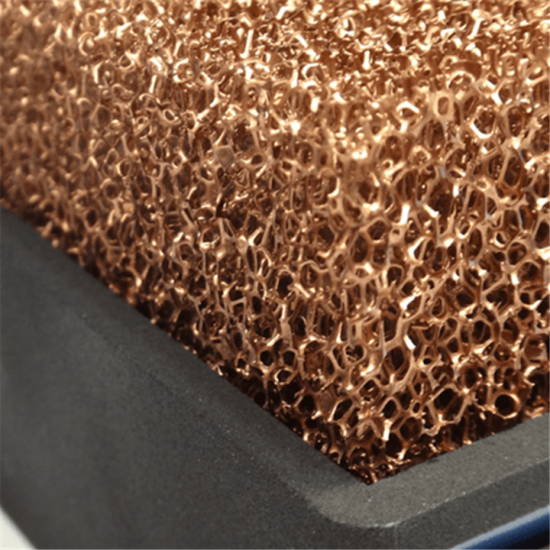
Copper foam heat sinks are a type of advanced porous material designed to enhance thermal management in electronic devices, power electronics, and high-performance experimental systems. Unlike traditional solid copper heat sinks, copper foam features a three-dimensional network of interconnected pores, providing a high surface area-to-volume ratio. This structure allows efficient heat dissipation through conduction within the foam and convection with the surrounding air or liquid.
In experimental research, copper foam heat sinks are increasingly utilized to study thermal transport mechanisms, optimize cooling strategies, and develop compact, lightweight, and high-efficiency thermal solutions for electronics, batteries, and energy systems. Their unique structure makes them particularly suitable for applications where conventional heat sinks cannot meet high heat flux requirements or compact design constraints.
Features
Copper foam heat sinks possess several distinctive features that make them highly effective for thermal management:
1. High Thermal Conductivity
Copper inherently has excellent thermal conductivity (~400 W/m·K), enabling rapid heat transfer from heat-generating components to the surrounding medium.
2. Porous 3D Structure
Open-cell architecture with controlled pore size and porosity increases surface area, enhancing convective heat transfer and fluid interaction.
3. Lightweight Design
Despite being made of copper, foam structures reduce overall weight compared to solid copper heat sinks, making them suitable for aerospace and portable electronics.
4. Customizable Geometry
Foam thickness, porosity, and pore morphology can be tailored for specific thermal requirements and experimental conditions.
5. Corrosion Resistance
Copper’s natural resistance to corrosion ensures durability, especially in humid or chemically active environments.
6. Compatibility with Fluids
Copper foam is compatible with air and liquid cooling systems, enabling hybrid thermal management solutions in advanced experimental setups.
Fabrication Process
The production of copper foam heat sinks typically involves several steps to achieve uniform pore structure and high thermal performance:
1. Foam Template Formation
A polymer or polyurethane template is prepared with a desired pore size and geometry.
2. Copper Deposition
Copper is deposited onto the template using electroplating, powder metallurgy, or chemical vapor deposition, creating a thin copper coating around the template structure.
3. Template Removal
The polymer template is removed through thermal decomposition, leaving behind a highly porous copper network.
4. Sintering and Compaction
The foam is heat-treated to strengthen the copper skeleton, reduce defects, and improve thermal conductivity.
5. Finishing and Machining
The foam can be cut, shaped, or integrated into experimental setups or electronic components to match the design requirements.
Open Cell Cu Foam
Applications
Copper foam heat sinks have wide-ranging applications in experimental research, electronics, and energy systems:
* Electronic Cooling
Used in CPUs, GPUs, power transistors, and LED devices to dissipate high heat flux efficiently.
* Battery Thermal Management
Applied in lithium-ion, sodium-ion, and solid-state battery experiments to maintain uniform temperature and prevent thermal runaway.
* Aerospace and Defense
Lightweight foam heat sinks enable high-performance cooling in constrained spaces, including satellites, UAVs, and military electronics.
* Heat Exchangers and Fluid Systems
Open-cell foam facilitates liquid or air flow for enhanced convective heat transfer in experimental fluid systems.
* Experimental Material Research
Used as a model system to study thermal conductivity, fluid dynamics, and multi-phase heat transfer in porous media.
Advantages
Copper foam heat sinks provide multiple advantages compared to conventional solid heat sinks:
1. Superior Heat Dissipation
High surface area and 3D pore connectivity enhance both conduction and convection, efficiently removing heat from critical components.
2. Lightweight Design
Reduced mass without sacrificing thermal performance makes them ideal for portable or aerospace applications.
3. Customizability
Pore size, density, and geometry can be tailored to optimize thermal performance for specific experimental conditions.
4. Enhanced Fluid Interaction
Open-cell structure improves airflow and liquid contact, enabling hybrid cooling strategies.
5. Durability and Stability
Copper foam is corrosion-resistant and maintains structural integrity under prolonged thermal cycling.
6. Integration Flexibility
Can be combined with conventional heat sinks, phase-change materials, or liquid cooling systems for advanced thermal management.
Conclusion
Copper foam heat sinks represent an advanced experimental material with superior thermal management capabilities. Their high thermal conductivity, open-cell structure, lightweight design, and customizable geometry make them ideal for research applications, electronic cooling, battery thermal management, and aerospace systems.
By providing efficient heat dissipation through combined conduction and convection mechanisms, copper foam heat sinks enable the development of compact, high-performance, and reliable thermal solutions. With their adaptability and effectiveness, these materials continue to play a critical role in advancing experimental research and next-generation electronics and energy systems.