Xiamen TJ Metal Material Co., Ltd. (referred to as TJ Company) was established in 2009 and is now an important private backbone enterprise in Fujian Province, headquartered in Xiamen City, Fujian Province.
Copper Foam Battery Materials: A High-Performance Porous Current Collector for Advanced Energy Storage
Overview
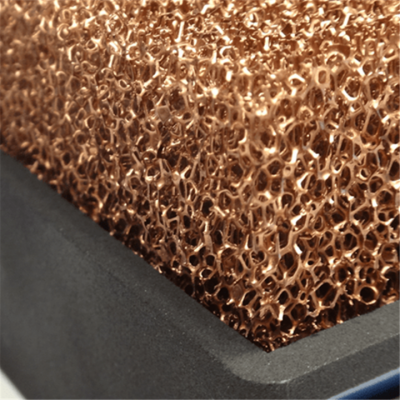
Copper foam battery materials refer to porous copper foam structures specifically designed for use in advanced battery systems as three-dimensional current collectors, conductive frameworks, and electrode substrates. Owing to their interconnected porous architecture, excellent electrical conductivity, and high mechanical stability, copper foam materials have become increasingly important in the development of lithium-ion batteries, lithium-metal batteries, sodium-ion batteries, solid-state batteries, zinc-ion batteries, and next-generation rechargeable energy storage devices.
Compared with conventional copper foil current collectors, copper foam battery materials provide a significantly larger surface area, enhanced electrolyte penetration, and improved electron transport pathways. Their three-dimensional network facilitates uniform active material loading while accommodating volume expansion during charge-discharge cycling, thereby improving battery capacity, cycling stability, and overall electrochemical performance.
Manufactured through advanced foaming, electroplating, powder metallurgy, or template-assisted fabrication techniques, copper foam is available in various pore sizes, porosities, thicknesses, and densities to meet diverse laboratory research and industrial development requirements. As demand grows for batteries with higher energy density, faster charging capability, and longer service life, copper foam continues to attract significant attention as a functional electrode material.
---
Key Characteristics
High-quality copper foam battery materials exhibit several unique structural and electrochemical properties that distinguish them from traditional flat current collectors.
Three-Dimensional Porous Structure
The interconnected porous network provides a significantly larger surface area than conventional copper foil. This architecture promotes uniform deposition of active materials while improving electrolyte accessibility and ion diffusion.
Excellent Electrical Conductivity
Copper possesses one of the highest electrical conductivities among engineering metals. The continuous metallic framework ensures efficient electron transport throughout the electrode, reducing internal resistance and improving power performance.
High Mechanical Strength
Despite its lightweight structure, copper foam offers excellent mechanical stability, allowing it to withstand repeated charging and discharging cycles while supporting active materials effectively.
High Porosity
Typical porosity ranges from 90% to 98%, providing abundant internal space for active material loading and accommodating electrode expansion during cycling, especially in silicon and lithium-metal anodes.
Superior Thermal Conductivity
Copper foam efficiently dissipates heat generated during battery operation, helping improve thermal management and reducing the risk of localized overheating.
Excellent Chemical Compatibility
Copper foam demonstrates good compatibility with a variety of battery chemistries and electrolytes, making it suitable for numerous electrochemical systems.
---
Manufacturing Process
The production of copper foam battery materials requires precise control over pore structure, density, and surface characteristics.
Raw Material Preparation
High-purity copper serves as the starting material. Material purity is carefully controlled to minimize impurities that could affect electrical conductivity and electrochemical performance.
Template Formation
One common manufacturing method uses polymer foam templates with controlled pore structures. The template determines the final pore size and interconnected network of the copper foam.
Electroplating
Copper is uniformly deposited onto the template through an electroplating process. Precise control of current density, electrolyte composition, and deposition time ensures consistent coating thickness.
Template Removal
After electroplating, the polymer template is removed through thermal decomposition or chemical dissolution, leaving behind a three-dimensional porous copper framework.
Sintering and Heat Treatment
In powder metallurgy production, copper powders are compacted and sintered at elevated temperatures to create a porous metallic structure with high mechanical strength and electrical conductivity.
Surface Modification
To further enhance electrochemical performance, copper foam may undergo additional treatments such as:
* Acid cleaning
* Surface polishing
* Carbon coating
* Graphene coating
* Nickel plating
* Oxide removal
* Plasma treatment
These modifications improve adhesion between the current collector and active materials while enhancing corrosion resistance.
Quality Inspection
Finished copper foam products are evaluated through comprehensive quality testing, including:
* Porosity measurement
* Pore size analysis
* Thickness inspection
* Electrical conductivity testing
* Tensile strength evaluation
* Surface cleanliness verification
* Corrosion resistance assessment
Open Cell Cu Foam
Applications
The unique properties of copper foam battery materials enable their use in numerous advanced energy storage applications.
Lithium-Ion Batteries
Copper foam functions as a three-dimensional current collector for high-capacity anode materials, improving electrical conductivity and increasing active material loading.
Lithium-Metal Batteries
Its porous architecture helps regulate lithium deposition, suppress dendrite formation, and improve cycling stability, making it highly attractive for lithium-metal battery research.
Solid-State Batteries
Copper foam serves as a conductive support structure that enhances interfacial contact between electrodes and solid electrolytes, contributing to lower resistance and improved energy density.
Sodium-Ion Batteries
Researchers use copper foam as an anode current collector to improve charge transport and mechanical stability in sodium-ion battery systems.
Silicon-Based Anodes
Silicon undergoes significant volume expansion during cycling. The porous copper framework accommodates this expansion while maintaining electrical contact, improving cycle life.
Supercapacitors
Copper foam provides an excellent conductive substrate for high-surface-area electrode materials, enabling rapid charge-discharge capability and high power density.
Fuel Cells and Electrochemical Devices
Beyond batteries, copper foam is used as a conductive framework in electrochemical reactors, catalyst supports, and fuel cell electrodes.
---
Advantages
Compared with conventional copper foil current collectors, copper foam battery materials offer numerous technical advantages.
* Larger Active Surface Area: The porous structure provides significantly more surface for active material loading, increasing energy storage capacity.
* Enhanced Electron Transport: The continuous three-dimensional metallic network ensures efficient electrical conductivity throughout the electrode.
* Improved Electrolyte Penetration: Open pores facilitate rapid electrolyte infiltration, enhancing ionic conductivity and reaction kinetics.
* Better Mechanical Stability: The robust framework accommodates electrode expansion and contraction, reducing mechanical degradation during cycling.
* Superior Thermal Management: High thermal conductivity helps dissipate heat effectively, contributing to safer battery operation.
* High Design Flexibility: Manufacturers can tailor pore size, porosity, thickness, and density to meet specific research or commercial requirements.
* Long-Term Cycling Performance: Improved structural stability and electrical contact contribute to enhanced capacity retention and extended battery lifespan.
---
Conclusion
Copper foam battery materials have emerged as a highly promising solution for next-generation energy storage systems. Their unique three-dimensional porous architecture, outstanding electrical conductivity, excellent thermal performance, and strong mechanical stability provide significant advantages over traditional flat current collectors. These characteristics make copper foam an ideal material for advanced lithium-ion, lithium-metal, sodium-ion, solid-state batteries, supercapacitors, and other electrochemical devices.
As battery technology continues to evolve toward higher energy density, faster charging, and longer cycle life, the role of copper foam in improving electrode design and electrochemical performance will become increasingly important. Ongoing advancements in manufacturing techniques, pore structure optimization, and surface engineering are further expanding the capabilities of this versatile material. With its exceptional combination of conductivity, durability, and adaptability, copper foam battery materials will continue to play a critical role in the development of safer, more efficient, and higher-performance energy storage solutions for both research laboratories and commercial applications.